Experiential Education

Experiential Ed.


Immersive programs that take students, faculty, and industry leaders beyond the classroom to build real-world skills for sustainable cities.
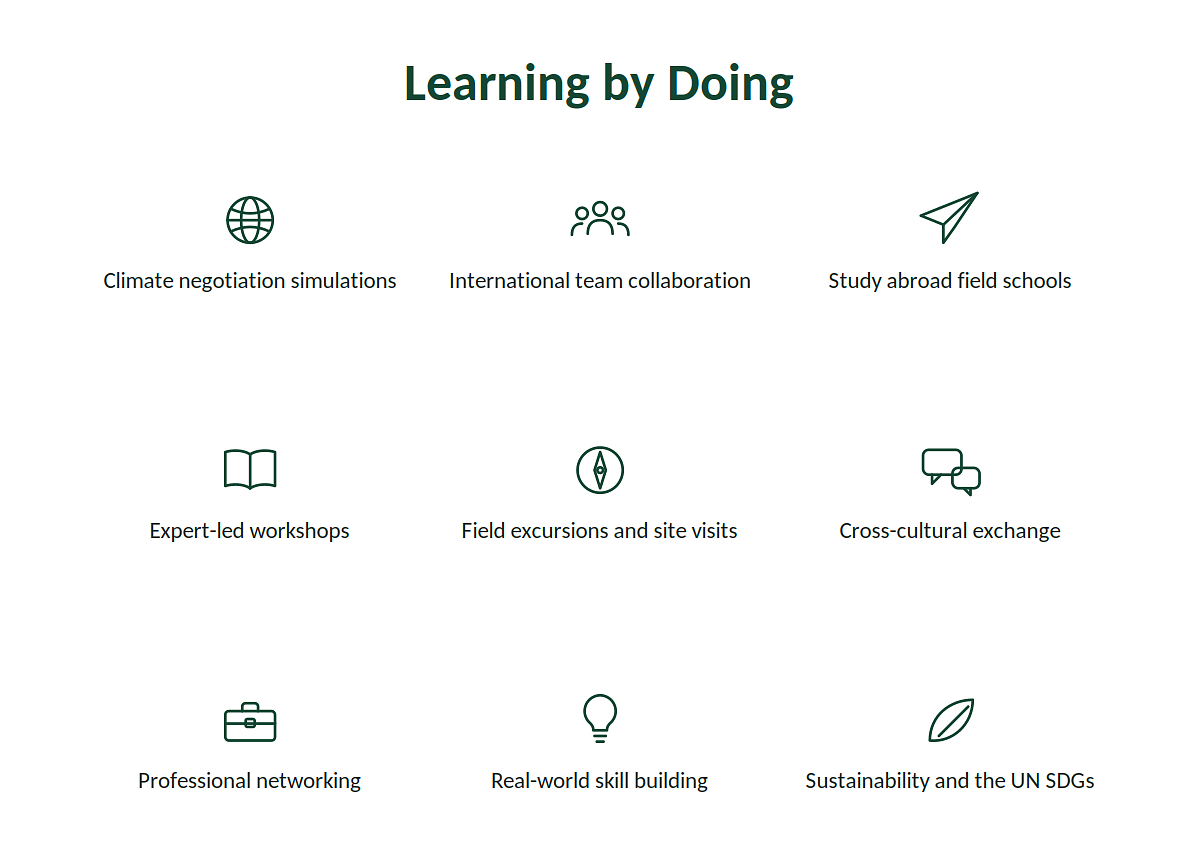


Learning by doing APRU SCL
 
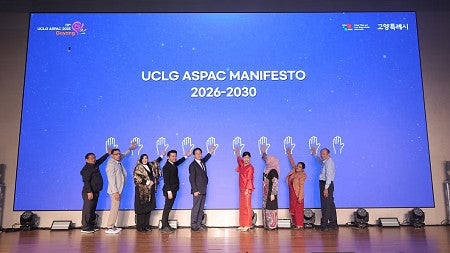
Nine Mayor's Academy participants standing giving a high five to a hand on a blue screen
Asia Pacific Mayor's Academy
The Academy is a joint initiative organized by the UNU Institute for the Advanced Study of Sustainability (UNU-IAS), the UN Economic and Social Commission for Asia and the Pacific (UNESCAP), UN-Habitat, United Cities and Local Government Asia Pacific (UCLG-ASPAC), the Association of Pacific Rim Universities (APRU), and the Institute for Global Environmental Strategies (IGES). The Asia-Pacific Mayors Academy engages newly elected or appointed city mayors/governors in the Asia-Pacific region to participate in an annual fellowship and build their capacities to develop and implement sustainable urban solutions in their communities, in support of the New Urban Agenda and the 2030 Agenda for Sustainable Development.
 
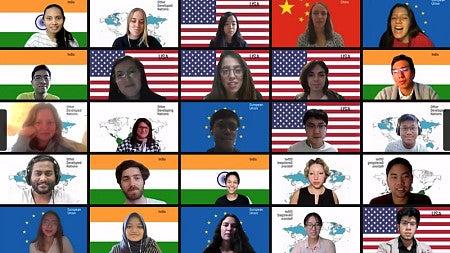
Group of students on a zoom box with country flags in the background
Certificate in Global Climate Change Leadership
The APRU Certificate in Global Climate Change Leadership is a role-playing exercise in which students will form multi-disciplinary teams to play the role of delegates to the UN Climate Change Negotiations. Students will be assigned to international teams (students from various universities) representing one of six economies/regions. Teams will hear perspectives from experts on topics such as coastal habitats, deforestation, clean energy, trading and offsets, and diplomacy and negotiation skills. Teams will discuss the human and environmental effects of climate change, as well as the economic impact that economies/regions consider in determining their position and global commitments.
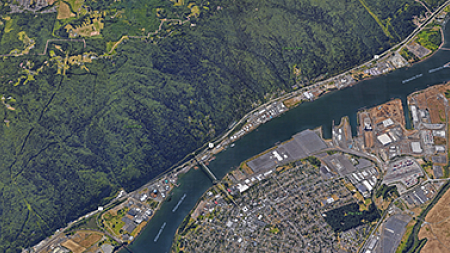
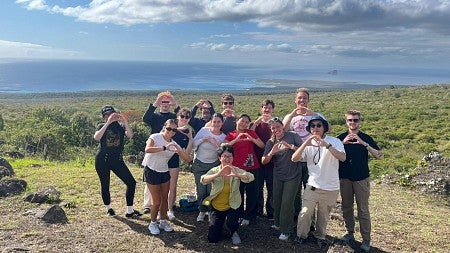
Group of students in Galapagos throwing their Oregon "O"
Galapagos Field School
This program spans 21 days in Quito and the Galápagos Islands, offering students interested in urban planning, architecture, and environmental conservation a unique, hands-on learning experience. Using the Galápagos as a case study, it explores the complex socio-ecological relationship between cities and landscapes and how the looming climate crisis may reshape it, through a mix of workshops, excursions, and lectures. It's a close collaboration between Global Education Oregon, the Universidad San Francisco de Quito Galápagos campus, and the APRU Sustainable Cities and Landscapes Program at the UO Global Studies Institute.
APRU Hub
Global Sustainability: Waste in The City
This seminar introduces graduate students to global sustainability through the eyes of leading academics and industry experts, centering on the United Nations Sustainable Development Goals with a focus on waste and urbanization. Students examine how leaders work with stakeholders to put sustainability into practice, and analyze real Environmental, Social, and Corporate Governance (ESG) reports from companies across industries to sharpen their critical thinking and analytical skills.
Upcoming Webinars


Webinar Series: Details Coming Soon
The APRU SCL Program hosts webinars each quarter, bringing together researchers, practitioners, and students from across the Pacific Rim to explore current questions in sustainable cities and landscapes. Dates, topics, and registration links for the next sessions will be posted here. In the meantime, browse recordings from past webinars below.
Past Webinars
Biodiversity for Sustainable Cities
APRU Biodiversity for Sustainable Cities Webinar Series 2024
This series tackled the pressing issue of biodiversity loss in urban environments, convening researchers, practitioners, educators, students, and stakeholders to explore innovative solutions. Jointly organized by the APRU Biodiversity and APRU Sustainable Cities and Landscapes Programs, in partnership with The Chinese University of Hong Kong, Shanghai Jiao Tong University, and The University of Sydney, the sessions focused on integrating biodiversity conservation into urban development strategies for a more sustainable future.

Speakers:

  • Prof. Gail Langellotto, Department of Horticulture, Oregon State University, "Cultivating Biodiversity in Small Spaces: Plants, People, and Practices"
  • Dr. Sohyun Park, Department of Plant Science and Landscape Architecture, University of Connecticut, "Biodiversity-Positive Design: Empirical Evidence and Case Studies"
  • Ms. Jennifer Rae Pierce, Co-founder and COO, Urban Biodiversity Hub; PhD Candidate, Department of Community and Regional Planning, University of British Columbia

Moderator:

  • Prof. Yekang Ko, School of Architecture & Environment, University of Oregon
Watch the Biodiversity for Sustainable Cities Webinar


Sustainable Urban Design Handbook
Discussion with Nico Larco and Kaarin Knudson about their book
Featuring Nico Larco, Professor of Architecture, and Kaarin Knudson, AIA, this webinar explored their publication The Sustainable Urban Design Handbook. Building on their extensive research, the handbook gathers best practices from across disciplines to advance sustainable urban design principles. In an era where urban areas host over half of the global population and face growing climate uncertainty, the discussion offered a framework for design and planning professionals, community stakeholders, students, and policymakers working to create sustainable communities.

Speakers:

  • Prof. Nico Larco, School of Architecture and Environment; Director, Urbanism Next Center, University of Oregon, US
  • Kaarin Knudson, Mayor of the City of Eugene, US

Moderator:

  • Prof. Paola Boarin, School of Architecture and Planning; Director, Future Cities Research Hub, University of Auckland, New Zealand

Watch the Discussion with Nico Larco and Kaarin Knudson Webinar

live webinar series
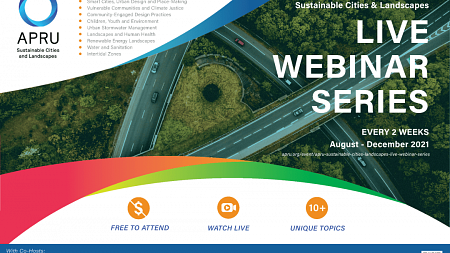
Live Webinar Series
This series connected researchers and scholars from across the Pacific Rim in cross-cultural conversations around climate justice, sustainability, and social equity. Sessions examined how cities around the world are working toward the United Nations' Sustainable Development Goals in their own contexts, spanning topics from vulnerable communities and climate justice to water and sanitation, energy, smart cities, and community design activism. The series was led by the APRU Sustainable Cities and Landscapes Program at the University of Oregon, alongside the University of Auckland, University of Hawaiʻi at Mānoa, and Arizona State University, with six additional participating APRU member institutions.

Learn more about each webinar session

Topics include:

  • Sustainable Cities and Landscapes Overview
  • Vulnerable Communities and Climate Justice
  • Water, Waste Water, and Sanitation
  • Coastal and Intertidal Zones
  • Energy
  • Smart Cities
  • Landscapes and Health
  • Children, Youth and Environment
  • Community Design Activism

Watch the live webinar recordings