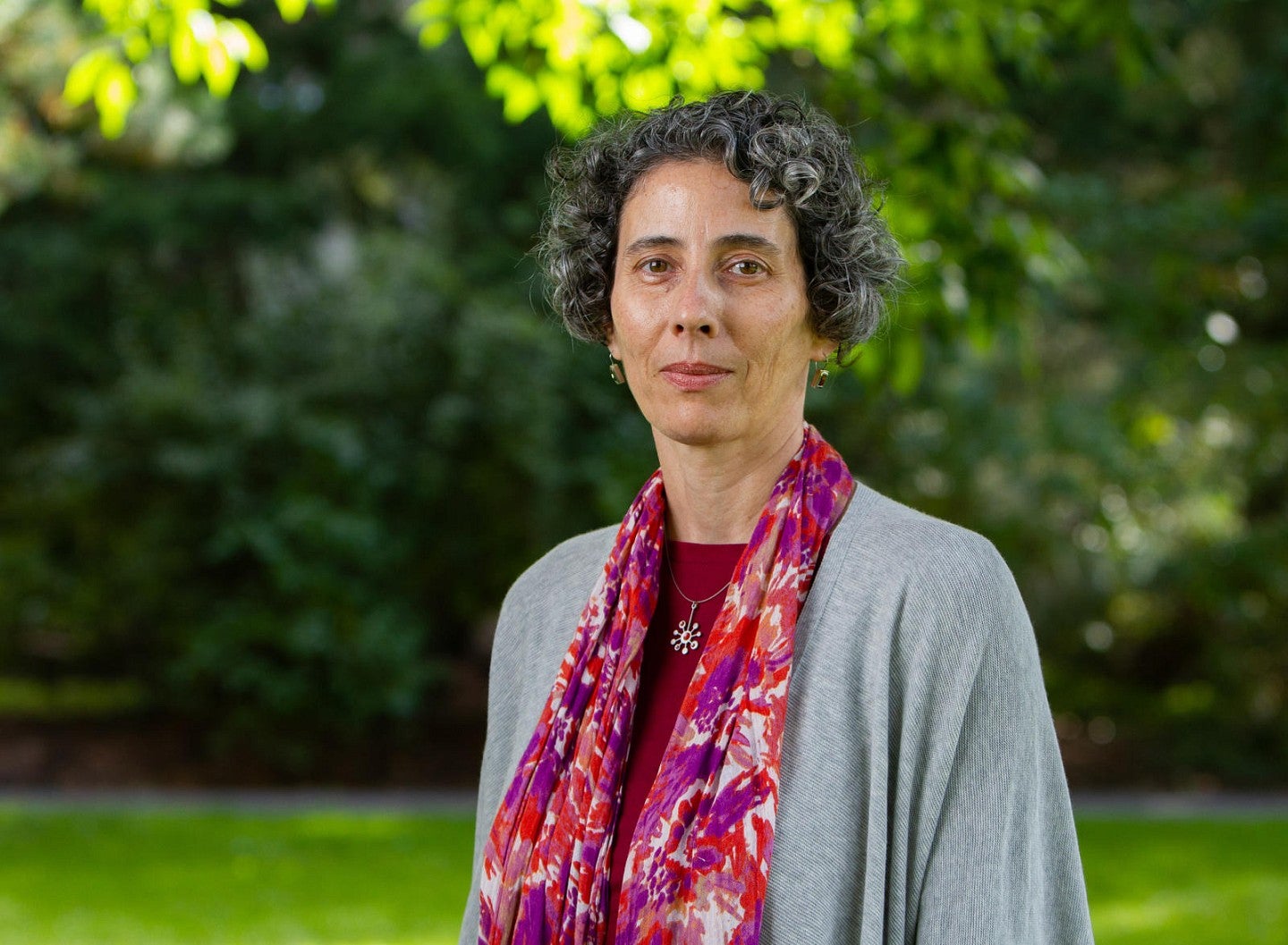
Rachel DiNitto is Director of the Center for Asian and Pacific Studies (CAPS) and Professor of Japanese Literature. She is a scholar of modern and contemporary Japanese literature, film, and environmental humanities, with particular expertise in cultural responses to nuclear disaster and environmental crisis in Japan. She has also served as Chair for UO’s East Asian Languages & Literatures Department and Director for William & Mary’s Asian and Middle Eastern Studies program. As director of CAPS, she leads and fosters initiatives that promote interdisciplinary and transnational teaching and research, public engagement, and collaboration between UO and our partners in Oregon, the US, and the Asia Pacific.
Rachel’s research examines the intersections of literature, cinema, disaster studies, and the nuclear environmental humanities. She is the author of Fukushima Fiction: The Literary Landscape of Japan’s Triple Disaster, which received Choice Magazine’s Outstanding Academic Title designation, and editor of Eco-Disasters in Japanese Cinema, a groundbreaking collection exploring environmental themes in Japanese film. UO recognized Rachel’s outstanding contributions with their Sustainability Award for Excellence in Teaching in 2021. Her current work investigates the long-term cultural and environmental legacies of nuclear harm in Japan and contributes to broader conversations in the environmental humanities. Visit her UO faculty page for more on her research.
Before joining the University of Oregon in 2015, Rachel taught at the College of William & Mary and held a postdoctoral fellowship at Harvard University’s Reischauer Institute for Japanese Studies. She earned her B.A. from the University of Pennsylvania and her M.A. and Ph.D. in Modern Japanese Literature from the University of Washington. Through her scholarship, teaching, and leadership, she is committed to fostering a deeper understanding of Asia and the Pacific and supporting globally engaged education and research.
Select Publications:
- Eco-Disasters in Japanese Cinema, ed. Ann Arbor: Association for Asian Studies/Columbia UP, 2024.
- Fukushima Fiction: The Literary Landscape of Japan’s Triple Disaster. Honolulu: University of Hawaii Press, 2019.
- “Defying the Nation: Nuclear Disasters and Japan.” In Mai Kataoka, Timon Screech, Oliver White, eds., Global Japanese History and Culture: De-Isolating Japan from Past to Present. Routledge, 2026.
- “Nuclear Anxiety, Environmental Crisis, and the Materiality of Waste in Kōbō Abe’s Cold War novel Ark Sakura (1984)". Interdisciplinary Studies in Literature and Environment. December 12, 2025. (open access)
- “Slow Violence and Japan’s Nuclear Future: Kirino Natsuo’s Baraka.” In Michele Mason and Hester Baer, eds., Nuclear Futures in the Post-Fukushima Age: Literature, Film, and Performance from Germany and Japan. Palgrave Macmillan, Literatures, Cultures, and the Environment Series, 2024.